Not Just a Blue Dot in a Sea of Red: April 5th Protests Across Rural America, The Daily Yonder
Daily Yonder, April 2025
IlanaNewman and Sarah Melotte
On April 5th, 2025, people took to the streets across the country to protest the Trump administration’s broad actions aimed at reducing, defunding, and – in specific cases – closing entirely various federal agencies. While there were large protests in cities like New York, Washington D.C., Chicago, and more, rural communities also showed up, sometimes with significant percentages of the local population.
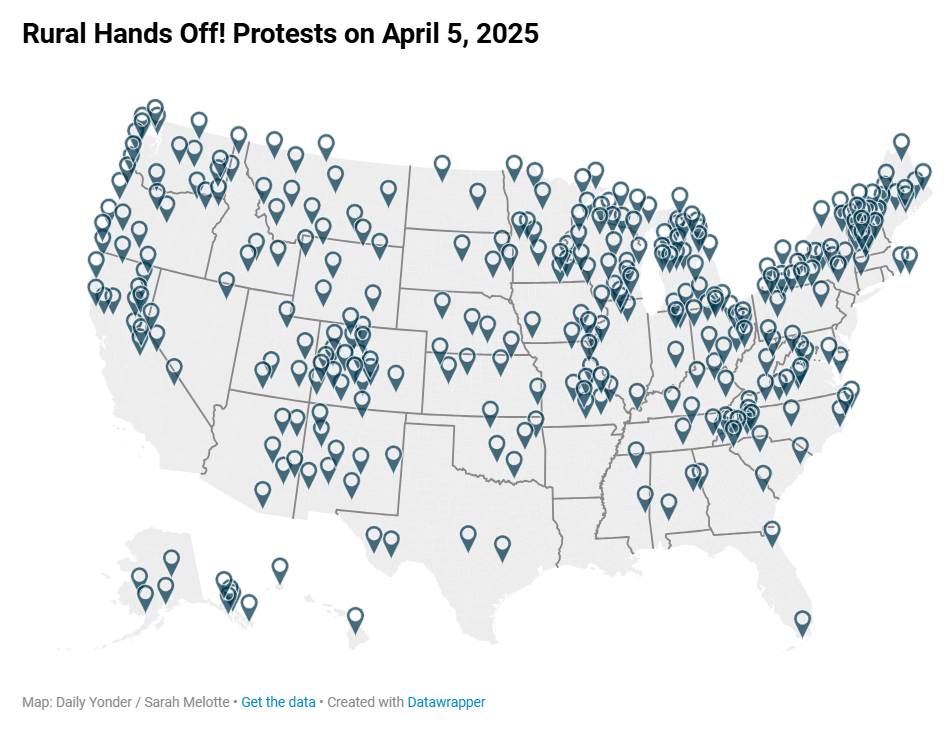
According to data compiled by We (The People) Dissent, and analyzed by the Daily Yonder, at least 400 protests, under a collective name of “Hands Off!,” took place in rural counties on Saturday, April 5th, with almost every state having at least one protest in a rural county.
In Cortez, Colorado, a town of 9,000, an estimated 600 people showed up for a Hands Off protest organized by the local League of Women Voters. That’s six percent of the city’s population and two percent of Montezuma County’s population — in a county that voted for Trump by 21 percentage points in 2024.
Karen Sheek, president of the Montezuma County League of Women Voters, said the Cortez gathering “wound up being a really wonderful, peaceful event that I think signifies that we have a whole community that’s got some concerns and we raise those in a peaceful and respectful manner.”
The event consisted of an almost a mile march down Main Street in Cortez, which is also part of Highway 160. After the march, many participants gathered at the Cortez Cultural Center to listen to speakers, who talked about the Trump administration’s effects on local issues from agriculture to public lands to healthcare, Sheek said.
“The First Amendment guarantees our right to peacefully assemble to petition our government and freedom of speech. On Saturday, 600 plus people in Montezuma County exercised that First Amendment right,” Sheek said.
In nearby Durango, around 1000 people gathered for another protest, in a town of 20,000. 60 miles further, in Pagosa Springs, Colorado, around 300 people protested in the town of 1,700 — about 17% of the population.
Booneville, Indiana, population of 6,246, had 37 people protesting on Saturday, said Laura King, who helped organize the event. Warrick County, Indiana, voted for Trump by 30 percentage points in 2024. King said the southwest Indiana community is small enough that you don’t talk about politics, in fear of ruining relationships, which makes showing up at a local protest intimidating for many.
The turnout was more than they anticipated. “It was a big deal to have that many people,” King said, “everyone was nervous at first, but surprisingly, we actually got a lot of positive feedback from the community.” Many cars driving by honked in support, and King said only a few people expressed any sort of negative feelings towards the protesters.
“The most important thing is visibility,” King said. “We have immigrants. We have people that are LGBTQ. We have people that are trans, and knowing that they have support I think is the biggest thing. People do care and people do support them even if everything you see around you says Trump, Trump, Trump.”
In Roseburg, Oregon, in a county that voted for Trump by 38 percentage points in 2024, around 1000 people gathered on Garden Valley Boulevard holding signs. “I’ve never seen anything like that here in Roseburg,” said Douglas County resident Audrey Squires, who attended the protest.
“The politicians at the national level have tried to divide us at the class level, and that wasn’t the case on Saturday,” Squires said. “I think there were people from a lot of different backgrounds and even different political beliefs on the street together.”
In China Grove, North Carolina, Joyce Nash knew she couldn’t make it to a bigger city for a larger protest. So she posted online saying she would go out by herself with a sign and stand on the sidewalk in the nearby town of Salisbury, the county seat. Census data categorizes 42% of Rowan County’s population as rural, however, some sources categorize it as a suburb of Charlotte, North Carolina.
Nash said her last minute event brought ten other people out to hold out signs on the sidewalk, many of whom did not know each other already. “There’s a lot of value in demonstrating that we’re not alone, we’re not blue dots in the sea of red. We’re all out here together,” said Nash.
According to self-reported data gathered by We (the People) Dissent, thousands of people showed up across rural America. In Daleville, Alabama, population 4,926, 100 people reportedly showed up. In Cherryfield, Maine, population 1,107, over 100 people protested. In Gardiner, Montana, population 791, 75 people reportedly gathered. In Ephrata, Washington, population 1,276, 70 people showed up.
The commonality in all these rural communities that organized protests, no matter the size of the turnout, was a feeling of solidarity and momentum. Every rural protest organizer and attendee talked to for this story expressed their motivation to continue to gather and organize in their small towns.
These protests show the value in showing up in small towns, even when it might feel pointless. King, in southwest Indiana, emphasized how important it is to have people on the ballot in otherwise uncontested races, and she hopes that these protests and gatherings will inspire more people to get involved.
“Hopefully we’ll incentivize people to participate either by protesting or getting involved with their local party to get the vote out or get people on the ballot, get people to run and know that they’ll have support,” King said.